
The Odyssey, The Ramayana, and the Science of Coming Home


What ancient epics still teach us about trauma, resilience, identity, and the human mind. Christopher Nolan’s adaptation of The Odyssey has reignited interest in one of history’s greatest stories. More than an epic adventure, Homer’s masterpiece is a profound exploration of uncertainty, temptation, leadership, resilience, identity, and the long journey back to oneself.
Yet there is another ancient epic that deserves equal attention.
Long before Homer, India was telling remarkably similar stories.
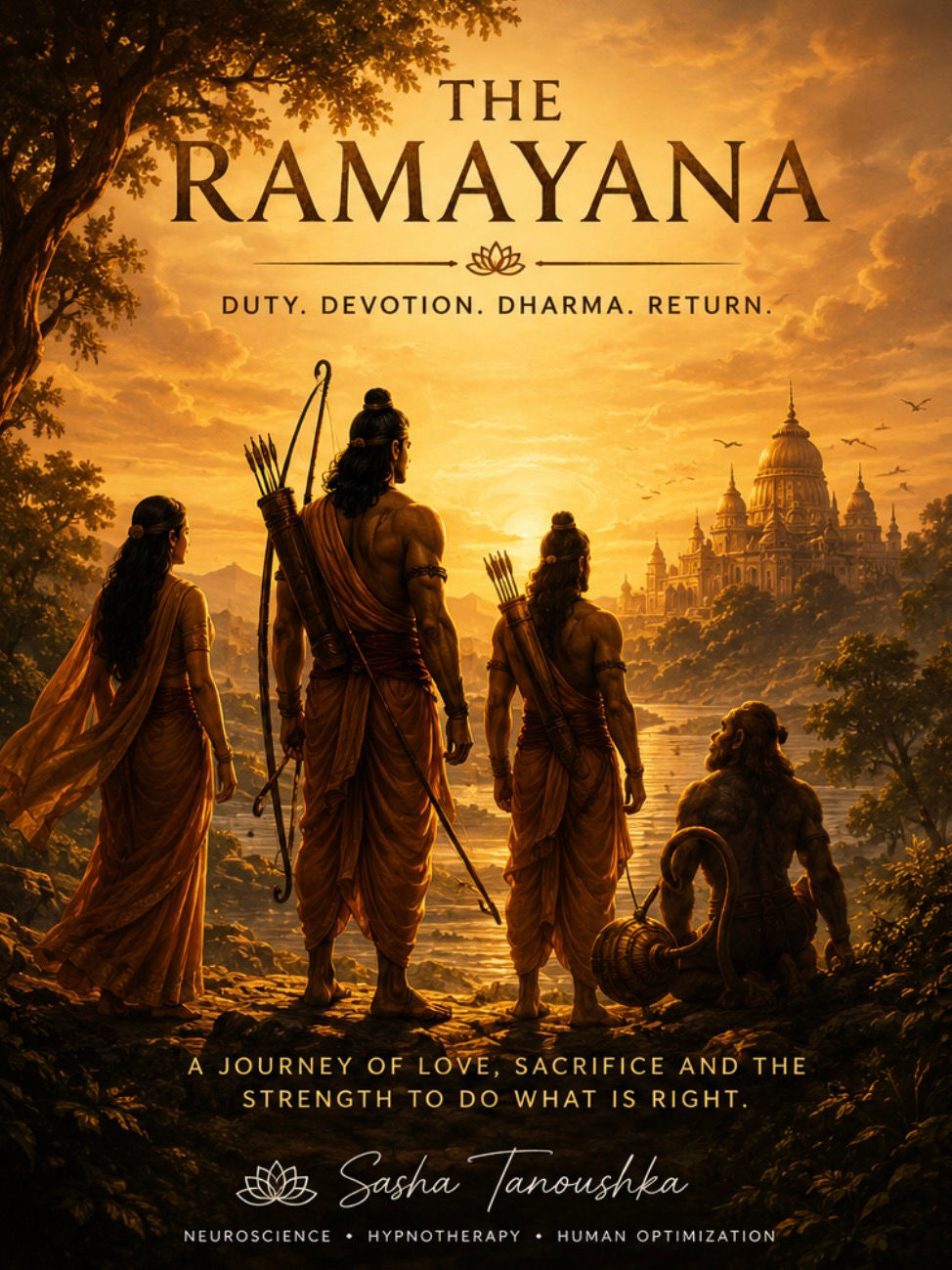
The Ramayana, traditionally attributed to the sage Valmiki, is generally regarded as one of the world’s oldest surviving epics. Many scholars date its composition to the first millennium BCE, while Hindu tradition holds that its origins are far older, preserved orally across generations before being written down.
Different cultures.
Different heroes.
Remarkably similar questions.
Ancient people understood psychology before psychology existed.
Modern neuroscience speaks about:
• nervous system regulation
• executive functioning
• trauma
• attachment
• resilience
• behavioural conditioning
Ancient storytellers wrapped these same ideas inside heroes, monsters, forests, oceans, kingdoms, and impossible journeys.
They were teaching emotional regulation thousands of years before psychology became a scientific discipline.
1. The greatest enemy is uncertainty
Odysseus spends much of his journey navigating incomplete information.
He rarely knows where he is, who can be trusted, or whether home still exists.
The uncertainty itself becomes part of the suffering.
Anyone who has experienced illness, divorce, migration, grief, or financial hardship understands this.
The nervous system craves certainty.
When it cannot predict what comes next, stress rises.
The Ramayana presents the same lesson.
Rama loses his kingdom overnight and is sent into exile. His future disappears instantly.
Rather than allowing uncertainty to define him, he chooses to let his values guide his actions.
Ancient wisdom repeatedly reminds us:
You cannot always control your circumstances.
You can always choose your character.
2. Comfort can quietly become another prison
The Lotus Eaters offer comfort without purpose.
Their gift removes pain.
It also removes the desire to continue the journey.
Modern life has its own versions of the lotus.
Infinite scrolling.
Alcohol.
Drugs.
Compulsive shopping.
Workaholism.
Constant distraction.
These behaviours often numb discomfort while quietly disconnecting us from meaning.
The Ramayana presents similar lessons through attachment, illusion, and desire.
Both epics ask the same question:
What comforts us today may prevent us from becoming who we are capable of tomorrow.
3. Willpower is rarely enough
When facing the Sirens, Odysseus does something remarkably modern.
He does not trust his future self.
Instead, he changes his environment.
He has himself tied to the mast.
He asks others not to release him, no matter what he says.
Modern behavioural science echoes this idea.
Environment often shapes behaviour more powerfully than motivation.
The Ramayana reaches the same conclusion.
Rama succeeds not alone, but with trusted companions such as Lakshmana and Hanuman.
Resilience grows through relationships.
4. Ego often extends suffering
Odysseus defeats the Cyclops.
He has already escaped.
Yet his need for recognition compels him to reveal his identity.
One impulsive moment transforms victory into another decade of hardship.
How often does ego prolong our own suffering?
The need to be right.
The need to have the last word.
The need to be recognised.
The Ramayana offers a contrasting example through Hanuman.
Despite immense power, he remains humble and devoted to service.
Across both traditions, humility emerges not as weakness, but as wisdom.
5. Every hero needs guidance
The English word mentor originates in The Odyssey.
Athena guides Telemachus by taking the form of Mentor, encouraging him to grow rather than rescuing him.
The Ramayana presents similar figures who encourage courage, responsibility, and independence instead of dependence.
The greatest teachers do not create followers.
They create capable individuals.
6. Success deserves careful definition
Ancient epics repeatedly challenge society’s definition of success.
Status.
Power.
Recognition.
Victory.
These alone rarely bring peace.
The Ramayana places duty, integrity, compassion, and service above personal ambition.
Both epics remind us that fulfilment is measured less by what we accumulate and more by who we become.
7. Coming home is often the hardest journey
Reaching the destination is only half the story.
The greater challenge is integrating everything the journey has changed within us.
Athletes experience it after winning championships.
Patients after recovery.
Veterans returning from war.
Immigrants returning home.
Parents after children leave.
People rebuilding life after trauma.
Getting home and feeling at home are different things.
The Ramayana understands this.
So does The Odyssey.
Both recognise that transformation continues long after the external battle is over.
Ancient wisdom meets modern neuroscience
Today we speak about neuroplasticity, vagal regulation, emotional flexibility, executive function, trauma recovery, and resilience.
Ancient storytellers described these same realities through metaphor.
The language has changed.
The human brain has not.
Technology evolves.
Human nature evolves far more slowly.
Final thoughts
Perhaps that is why these stories continue to endure.Not because they teach us about ancient heroes.But because they continue to teach us about ourselves.
Every generation faces uncertainty.
Every generation wrestles with temptation.
Every generation searches for purpose.
Every generation longs to find its way home.
The greatest stories survive because they illuminate something timeless:
The longest journey any of us will ever take is not across oceans or kingdoms.
It is the journey back to ourselves.
~ Sasha Tanoushka


Comments