
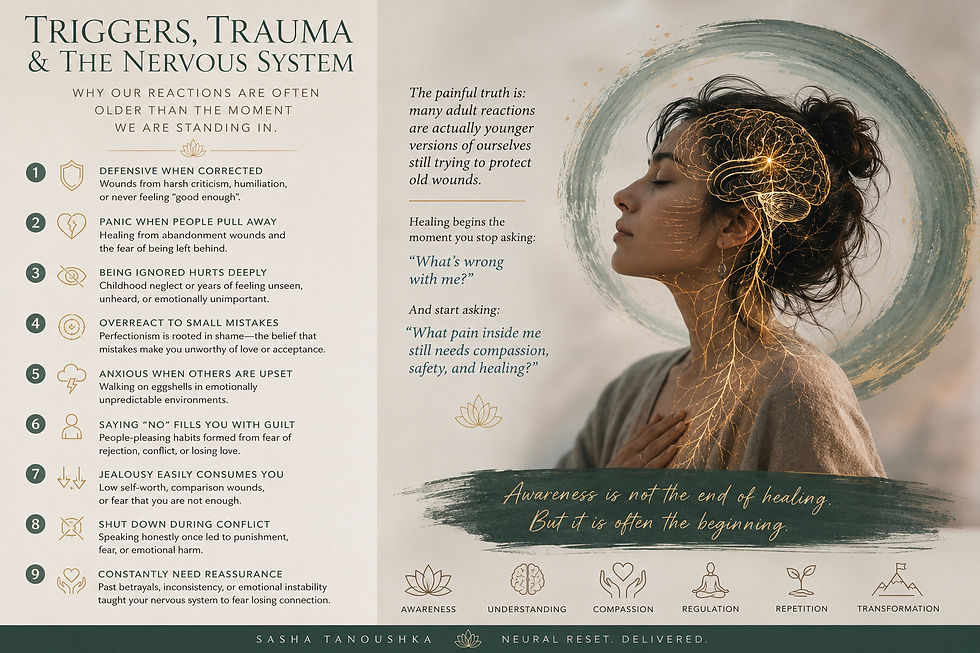
Triggers, Trauma & The Nervous System Why our reactions are often older than the moment we are standing in

Many people move through life believing their emotional reactions are simply “personality traits.”
Too sensitive. Too defensive. Too jealous. Too needy. Too distant.
But neuroscience increasingly suggests something deeper.
What we call “triggers” are often nervous system responses shaped through repetition, memory, emotional conditioning, and survival adaptation. The body and brain learn patterns through experience. When certain experiences repeat, especially during childhood or prolonged stress, the nervous system begins predicting danger before conscious thought even arrives.
A raised voice may not just feel like a raised voice.
Silence may not just feel like silence.
Distance may not just feel like space.
To one nervous system, these moments are neutral.
To another, they may feel life-threatening.
This is why some people panic when someone pulls away emotionally. Why criticism feels unbearable to others. Why conflict creates shutdown, rage, or overwhelming anxiety.
The reaction is not weakness.
Often, it is protection.
The Brain Learns Through Repetition
Neural pathways strengthen through repeated experiences. This is known as neuroplasticity.
If a child grows up in an unpredictable environment, the brain may become hypervigilant. If love feels conditional, the nervous system may associate mistakes with rejection. If emotional expression once led to punishment, silence may become a survival strategy.
Over time, these reactions become automatic.
Not because the person is “broken.”
Because the nervous system adapted intelligently to survive the environment it was placed within.
The difficulty is that survival patterns formed in one chapter of life often continue operating long after the original threat has disappeared.
A Buddhist Reflection
Buddhist philosophy has long explored the concept of suffering arising from conditioning, attachment, fear, and unconscious repetition.
In many Buddhist traditions, healing is not achieved through suppression of emotion, but through awareness of it.
To observe without immediately reacting.
To witness without becoming consumed.
To notice the trigger before becoming the trigger.
The mind is trainable.
Attention is trainable.
Compassion is trainable.
This aligns remarkably with modern neuroscience. Meditation and mindfulness practices have been associated in research with measurable changes in emotional regulation, attentional control, stress reduction, and activity within brain regions linked to self-awareness and fear processing. Practices rooted in contemplative traditions can absolutely support nervous system regulation over time.
However, religious or spiritual belief alone does not automatically regulate the nervous system.
A person may deeply believe in compassion, forgiveness, God, Buddhism, or spiritual truth while still carrying chronic hypervigilance, trauma activation, panic loops, dissociation, or emotional dysregulation.
Why?
Because intellectual belief and physiological regulation are not identical processes.
The nervous system changes through repeated embodied experience, safety, practice, environment, sleep, nutrition, movement, breath, relationships, emotional processing, and often therapeutic intervention. Belief can support healing. Community can support healing. Spiritual frameworks can support healing.
But the brain still requires regulation through lived experience and consistent neural conditioning.
This is not an attack on spirituality.
If anything, it is an invitation toward integration.
Healing Is Not Becoming Emotionless
Healing does not mean you never feel triggered again.
Healing may look more like:
pausing before reacting
noticing shame without collapsing into it
learning to tolerate difficult conversations
setting boundaries without guilt
recognising that another person’s behaviour is not always a reflection of your worth
staying connected to yourself during discomfort
Sometimes healing looks profoundly unremarkable from the outside.
A calmer text message.
A deeper breath.
One less impulsive reaction.
One honest conversation.
One evening not spent abandoning yourself to keep the peace.
Quiet changes.
Invisible rewiring.
And over time, those repetitions become identity.
Reflection
The question is often not:
“What is wrong with me?”
But perhaps:
“What has my nervous system learned to fear?”
“What pattern is trying to protect me?”
“What would safety feel like in my body?”
Awareness is not the end of healing.
But it is often the beginning.
Sasha Tanoushka BCH I HypnoChic I Neuroacoustics I Neurofeedback I
Neural Reset. Delivered.


Comments