
Back to School Without the Parenting Panic

🎒 BACK TO SCHOOL: YOUR CHILD DOES NOT NEED A PERFECT PHILOSOPHY. THEY NEED A WORKABLE ONE.
September has a way of turning parenting into a referendum. Should children be pushed or protected? Should hobbies be chosen or assigned? Should childhood be playful or strategic? Should passion lead, or does discipline come first?

Parents and grandparents are surrounded by competing narratives, often delivered with absolute confidence.
One says: Let children find themselves.
Another says: If you do not train them early, they will fall behind.
For already stretched families, that can create more anxiety than clarity. The research suggests something less dramatic and more useful:
Children tend to benefit from both structure and autonomy. Self-determination research consistently identifies three important psychological needs: competence, autonomy and relatedness.
A large meta-analysis involving more than 79,000 students found that competence was strongly associated with self-determined motivation, followed by autonomy and relatedness. In other words, children benefit from developing skill, but also from experiencing some ownership over what they are doing.
That matters when we think about the “wealthy families force hobbies” argument.
There is truth in one part of it.
🎹 Repeated practice builds skill.
♟️ Structured activities can teach persistence.
⚽ Sport can develop competence, relationships and confidence.
🎻 Music requires tolerating frustration before mastery becomes rewarding.
Deliberate practice matters. A meta-analysis found that it explained meaningful variation in performance, particularly in games, music and sport. But it was not the whole story. In music, deliberate practice explained about 21% of performance differences; in sport, about 18%. Talent development is more complicated than “practice hard enough and success follows.”
And structured extracurricular activity itself can be beneficial. An umbrella review found a small positive association between organized activities, particularly sport, and youth mental health, although the evidence was heterogeneous and stronger for sport than non-sport activities.
So structure is not the enemy.
But neither is play.
🌿 Unstructured play gives children opportunities to experiment, negotiate, imagine, move, take manageable risks and discover what genuinely captures their attention. Systematic-review evidence on nature play suggests benefits across several areas of child health and development, though the research base is still developing.
And excessive control has its own risks.
Parenting research increasingly distinguishes structure from control.
Structure says:
There is a routine.
You need to practise.
You cannot quit every time something becomes uncomfortable.
I will help you develop competence.
Control says:
Your preferences do not matter.
My anxiety determines your path.
Your performance determines my approval.
You must become the child I imagined.
Those are not the same thing.
Research grounded in self-determination theory suggests that children flourish when parents combine structure, involvement and autonomy support, rather than treating those qualities as opposites. That gives us a much better back-to-school question.
Not:
“Do I push or do I let go?”
But,
“Where does my child need structure, and where are they ready for more agency?”
A five-year-old and a seventeen-year-old will obviously need different answers.
So will two children in the same family.
One may need encouragement to persist after the novelty disappears.
Another may already be carrying perfectionism and need permission to play badly at something.
One child may flourish when piano practice becomes routine.
Another may discover that piano was never theirs, but music production is.
The objective is not to raise a child who obeys indefinitely. Nor is it to create a childhood where discomfort is continually removed. It is to gradually develop a person who can:
🧠 focus when something matters
💪🏽 tolerate frustration
🎨 remain curious
🌿 rest without guilt
🤝 cooperate with others
🎯 practise toward a goal
💛 recognise their own preferences
🔄 change direction thoughtfully when evidence tells them something is not working
That is a very different definition of resilience from simply “doing hard things.”
Resilience includes knowing which hard things are worth doing.
And there is another piece parents rarely hear enough:
You are operating under real constraints too.
Money. Work schedules. Transportation. Siblings. Caregiving. Health. School availability. Your own exhaustion.
Not every child needs violin, fencing, Mandarin and tennis to have a meaningful developmental advantage. The family meal they help cook, the community team they attend consistently, walking the dog every morning, learning an instrument at school, caring for a garden, volunteering with a grandparent, or sticking with one inexpensive activity can all teach responsibility and competence.
The objective is not to reproduce somebody else’s version of an “elite childhood.”
It is to create enough challenge, belonging, repetition, freedom and recovery for the child in front of you.
Perhaps that is the anchor parents need this September:
Give them roots and room.
Create routines.
Expect contribution.
Expose them to possibilities.
Let them experience boredom.
Do not rescue them from every frustration.
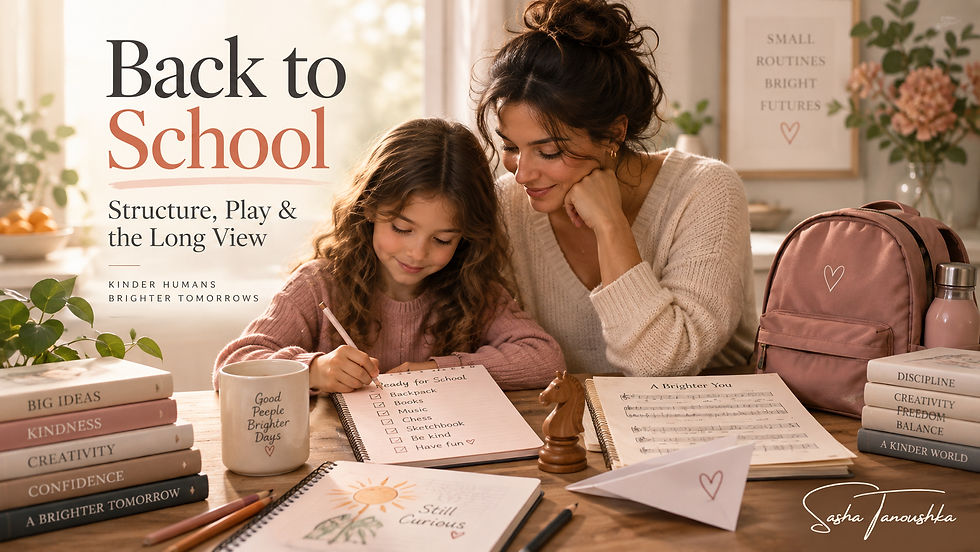
And listen closely enough to notice when persistence is becoming coercion rather than growth.
Childhood can contain both discipline and delight. It probably needs both.
References:
Sasha Tanoushka | Verus Human Optimization
Behavioural science • Family • Human potential • Healthy


Comments